Cycling from Witów: the Route around the Tatras and the Chochołowska Valley
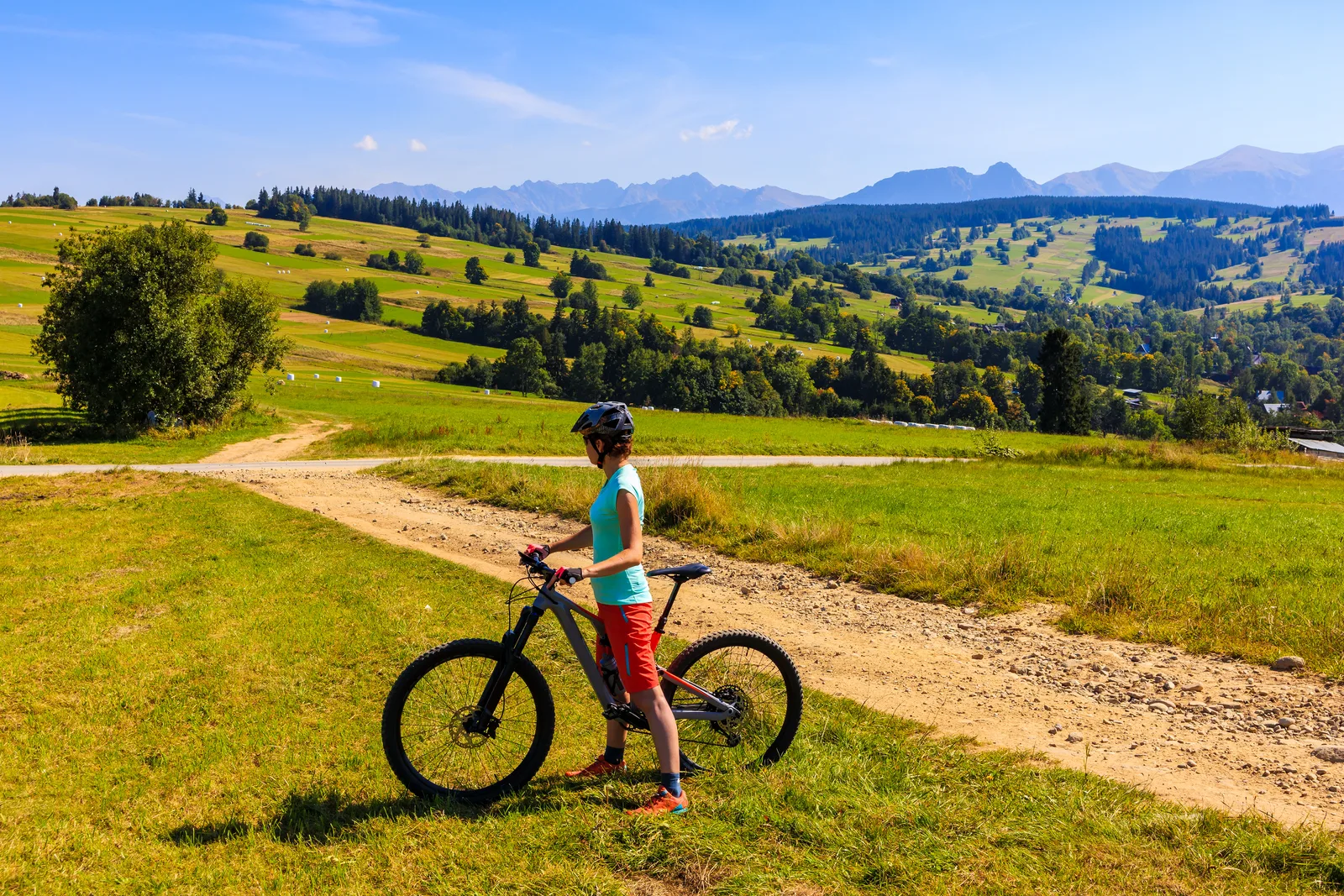
Three metres wide, smooth tarmac, no cars, and an old railway embankment instead of climbs. At Podczerwone you join a route an eight-year-old can ride comfortably.
The Rezydencja Kojsówka team · · 8 min read
In brief
- The Route around the Tatras is a Polish-Slovak loop of over 280 km, crossing Podhale, Orawa, Liptov and Spiš.
- The Polish main section is 20.6 km long and three metres wide, running on tarmac along the embankment of a railway that operated until 1989.
- On the Slovak side a further 14.4 km leads to Trstená; from Nowy Targ that makes about 35 km in all.
- The route passes through Ludźmierz, Rogoźnik, Stare Bystre, Czarny Dunajec and Podczerwone — and Podczerwone is the easiest place to join it from Witów.
- The Chochołowska is the only large Tatra valley open to bicycles; in the Kościeliska they are banned.
Podhale makes people think of mountains, and mountains of climbs, and that is usually enough for a family with children to leave the bikes at home. Needlessly, because a few kilometres from us runs a route with practically no climbs at all, because it was laid along an old railway embankment.
It is the simplest way to ride a dozen kilometres or more with a child without an argument over “one more hill”. And for stronger riders it is a chance to cross into Slovakia and be back for lunch.
The Route around the Tatras: what it actually is
| Detail | Value |
|---|---|
| The whole loop | over 280 km, Poland and Slovakia |
| Regions | Podhale, Orawa, Liptov, Spiš |
| Main section on the Polish side | 20.6 km of tarmac, 3 m wide |
| Surface base | the embankment of a railway that operated until 1989 |
| Places along the way | Ludźmierz, Rogoźnik, Stare Bystre, Czarny Dunajec, Podczerwone |
| Slovak section | 14.4 km to Trstená |
| Nowy Targ – Trstená in total | about 35 km |
| Character | flat, traffic-free, waymarked |
The key word is “embankment”. A railway line could not have steep gradients, so the route built along it is flat along almost its whole length. Add three metres of width and smooth tarmac, and you have conditions you will not find anywhere else in Podhale.
Joining at Podczerwone: our starting point
From Witów the nearest place to join the route is Podczerwone, beyond Chochołów, towards Czarny Dunajec. It is a convenient point, because it lets you skip the ride to Nowy Targ and start straight on the path.
From there you have two directions. West, towards the border and on to Trstená: shorter, with crossing the border as an attraction in itself. Or east, through Czarny Dunajec and Stare Bystre towards Nowy Targ: longer, through more Podhale villages.
Four versions for different levels
- Family: Podczerwone – Czarny Dunajec and back. Flat, short, and you can turn round at any point.
- International: Podczerwone – the border – Trstená. Lunch on the Slovak side and back the same way.
- Full day: Nowy Targ – Trstená, about 35 km one way, with a lift in one direction.
- Ambitious: further sections of the 280-kilometre loop, spread over several days of a stay.
The Chochołowska Valley: the only one open to bikes
This surprises most visitors: you may cycle along the floor of the Chochołowska Valley. There is a hire point on site, so you do not have to bring your own.
Riding to the hut on Polana Chochołowska takes considerably less time than the walk, which is 2 hours 10 minutes on foot. That leaves time and energy for what happens higher up — the climb to Grześ or Trzydniowiański Wierch, for instance.
For the record: in the neighbouring Kościeliska Valley both cars and bicycles are banned. Transport there is by traditional horse-drawn cart only. Worth knowing before you strap the bikes to the roof.
Practicalities
- Identification, if you are crossing into Slovakia; even with free movement it is worth having.
- Helmets for children and a high-visibility vest for the link sections between the path and the road.
- Water and a snack: there are villages along the way, but stretches between them can be empty.
- A spare inner tube and a pump: the tarmac is smooth, but a breakdown a dozen kilometres from the car is a problem.
- A waterproof jacket: in open Podhale the weather changes faster than in the valley.
- Our large free car park means the bikes can stay here between one outing and the next.
When to go
The season starts in spring, as soon as the snow has gone, and lasts into late autumn. It is most enjoyable in May, June and September: warm, but without the summer crush. In July and August it is worth setting off in the morning, as there is no shade on the open path and at midday it can get hot.
The best part comes afterwards: the wood-fired hot tub and an evening in the garden by the river. After several dozen kilometres in your legs it works better than any massage.
Źródła
Last updated: . Walking times, opening hours and prices are given as a guide. Check the current details and conditions before you set off.
More in this category
On two wheelsAuthor
The Rezydencja Kojsówka team
Hosts of the house in Witów
We run Rezydencja Kojsówka in Witów, at the mouth of the Chochołowska Valley. The posts on this blog come from what guests ask us over breakfast, filled out with information from walking maps and from Tatra National Park material.